By Devansu Khatiwada
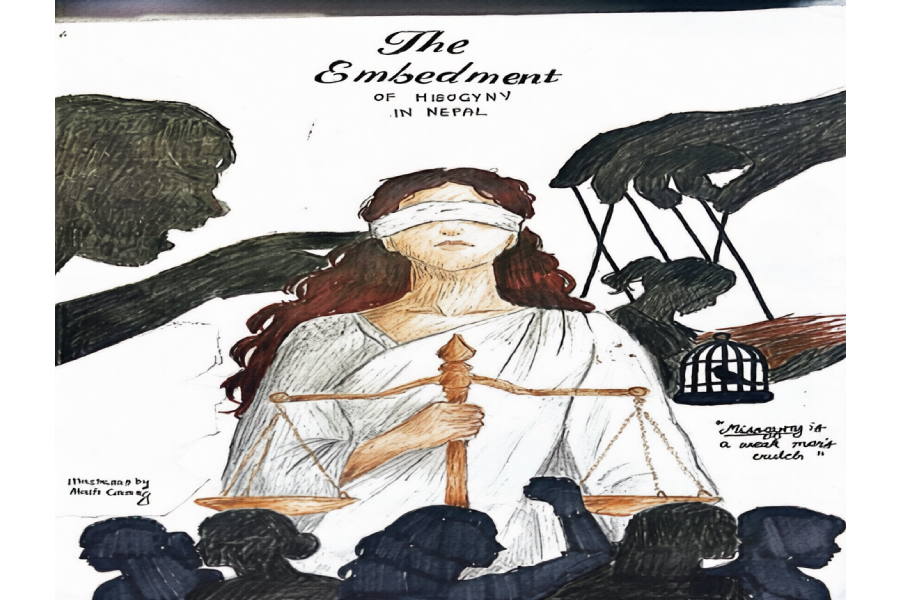
Misogyny is defined as the hatred, contempt, or deeply ingrained prejudice against women or
girls. In many countries, it can be seen as a ‘societal norm’ and is completely engrained into
their culture, traditions, superstitions, etc. The same can be said for Nepal. Especially in rural
areas, women are seen as inferior and treated like objects. They are deemed to have a fragile
mentality and are seen as nothing but providers – cooking food and washing dishes is the
only thing that they can apparently do without making mistakes. This attitude diminishes the
many hopes of young girls who aspire to make a change in their society.
The term “misogyny” is derived from the Ancient Greek word “mīsoguníā”, which means
hatred towards women. It can be seen even in the smallest of actions: from threatening and
violent behaviour to treating women differently from men in professional settings. Being
controlling of women, objectifying and belittling them, maintaining double standards for a
man and a woman – all these are signs of misogyny. No matter how subtle and minor they
seem, such behaviours affect how our women perceive their role in the community.
Many religions paint the picture of women as beautiful and pure beings: they deeply respect
the feminine aspect of divinity. However, they also shine a negative light on them; women are
portrayed as obedient and submissive, and the female gender as a curse. It’s an ideology that
took over even the wisest minds in history. Take Aristotle, for example – the famous Greek
philosopher whose ideas changed the mindsets of many. Who would have thought that he
believed in the inferiority of women, and assumed them to be a ‘deformity?’ Over centuries,
no matter how much women raised their voices, or worked hard for their positions, the
spotlight would always be stolen by men. And after a while, many started to fall into the
rabbit hole – a bottomless hole of oppression that even today forms a constricting mentality
In Nepal, too, misogyny remains embedded in our roots. Certain idioms and phrases in our
language have gendered profanity that ridicules women. Social practices or superstitions that
are still ongoing can be traced back to misogyny – for example, Chhaupadi. Chhaupadi is a
practice that only applies to women, when they enter the menstruation cycle. They are sent to
live in sheds for however long it may take, and this reflects how we are thought of as impure.
The practice of dowry can also be seen as a form of misogyny, since the bride’s family is
expected to give money, jewellery, etc. for her to be married. This practice depicts the low
value of women, and how they must be bought off by men to have a marital life. During
festivals such as Dashain and Tihar, who is expected to cook, clean the dishes, and pray for
their husband’s or son’s long life? Even during Teej, mostly celebrated by women, and
dedicated to women, they still must fast and pray for their husband’s longevity, and
unmarried women must pray for a good spouse – as if implying that a woman’s whole
purpose is to marry and serve.
When, in fact, we can do so much more.
The patriarchy and male-led society has corrupted many young women’s minds, allowing
them to believe that they are nothing. Misogyny remains a significant issue that affects both
individuals and society. Whether it appears through discrimination, stereotypes, unequal
opportunities, or harmful attitudes, its impact can be far-reaching.
But change can happen, though it probably won’t happen overnight. The feminist movements
led by the Suffragettes, for example, took a long time to be fully noticed, and the government
only started to act once women started to risk their lives, chain themselves against
government railings, and disrupted political meetings.
Change can happen when we advocate against misogyny, promote healthy masculinity, call
out subtle microaggressions, and support women’s leadership.
Addressing misogyny requires awareness, education, and a commitment to treating everyone
with respect and equality. By challenging prejudiced beliefs and promoting fairness, society
can move toward a future where people are valued for their abilities and character rather than
for their gender.